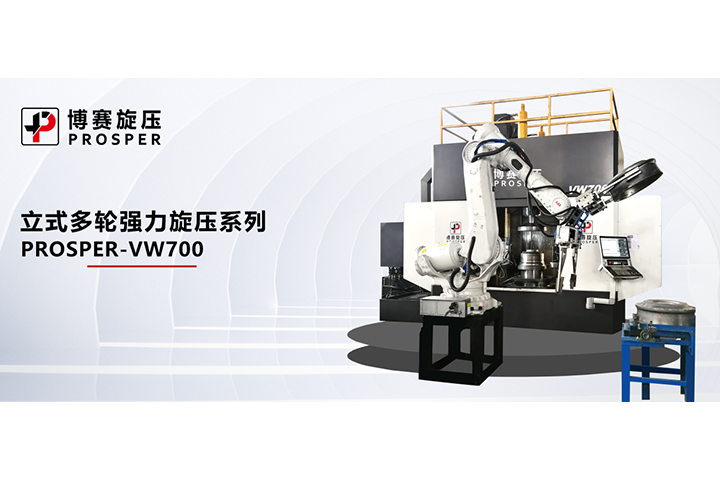
Release Stress First, Release Productivity Then In the world of metal forming, the spinning machine is renowned as a tool that "turns metal into gold." It transforms an ordinary metal disc into hi
Date: Mar,04 2026 View:
Release Stress First, Release Productivity Then
In the world of metal forming, the spinning machine is renowned as a tool that "turns metal into gold." It transforms an ordinary metal disc into high-precision wheels, lightweight gas cylinders, and even aerospace-grade fuel tanks through the dance of rotation and pressure. However, on the path to ultimate forming precision, there is an invisible enemy lurking within every machine—mechanical stress. What is stress? Stress is an internal "counterforce" generated in metal during casting, welding, or cutting due to uneven heating or external forces. This force lies dormant but, as temperatures change and time passes, releases silently, causing subtle bed warping and guide rail deformation. Without stress relief, precision cannot survive.The more precision required of a spinning machine, the more attention must be paid to stress relief. It's like the "internal energy cultivation" in traditional Chinese martial arts—invisible on the surface, yet determining explosive power and stability at critical moments. For a spinning machine, this means that even with perfectly accurate programming, the spun workpieces may become elliptical. It means that a newly commissioned machine performs with perfect precision, but six months later, that precision cannot be restored. So, how should stress be released? In the past, people would submerge castings in the sea or bury them underground, letting time release the stress. Today, we rely more on scientific combinations of processes. Before every spinning machine bed enters the finishing stage, we do three things: First, rough machining followed by aging. After casting, the bed undergoes rough machining. Once the outer layer is removed, the previously constrained internal stress begins to redistribute. At this stage, whether we use thermal aging (slow heating in a furnace followed by slow cooling) or vibratory aging (using resonance to release residual stress between microscopic grains), it's like giving the metal a deep "therapy session" to relax its tense structure. Second, multi-process superposition. For welded components of the spinning machine, shot peening can be applied. Countless tiny shots bombard the surface, implanting compressive residual stress to counteract future tensile stress during operation. For critical connection points, rolling processes strengthen the surface, multiplying fatigue life. Third, natural aging treatment.After casting, we place the bed in an open-air environment for six months.Natural aging allows microscopic stresses to fully release. The essence of a spinning machine's work is "using rigidity to overcome rigidity." The spindle rotates at thousands of revolutions per minute, exerting tens of tons of spinning force onto a metal plate. If the machine's own "body" still harbors unreleased stress, how can it precisely control external forces? Only a bed that has undergone deep aging can withstand years of heavy-load spinning without deforming. Only equipment stable at its core can deliver workpieces with near-100% qualification rates in every rotation.True productivity is always built upon invisible stability.